Research
Interpretability, medical imaging, and AI and art.
Norm Share Decides Whether a Subspace Ablation Removes the Feature or the Model
Two different operations both get called feature ablation, and on the same features one quietly removes a single language while the other breaks the whole model. One cheap number decides which happens, norm share, the fraction of a token's size carried by the directions you remove, and it takes a single forward pass to measure. With a clean removal in hand we tested the claim that language-specific features get in the way of multilingual reasoning, and across three model families removing them never helped.
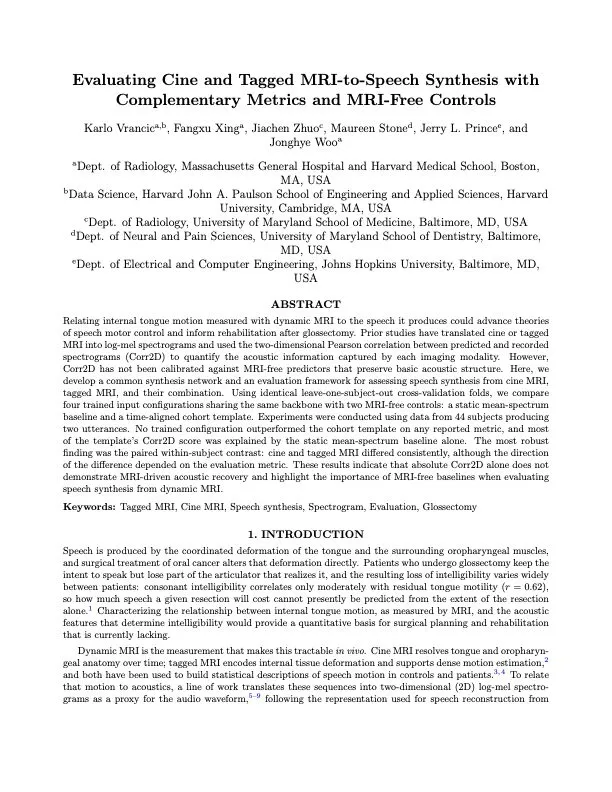
Evaluating Cine and Tagged MRI-to-Speech Synthesis with Complementary Metrics and MRI-Free Controls
A line of papers turns MRI videos of the tongue into speech and scores how closely the predicted sound matches the recording. I rebuilt that setup with one network for cine MRI, tagged MRI and both together, and added two baselines that never see an MRI, the average spectrum and an average utterance lined up in time. Across 44 speakers no model trained on MRI beat the baseline that never saw one, and most of the standard score came from the plain average alone. The one result that held was a consistent difference between the two kinds of MRI within the same person, so the usual score on its own does not show that any sound was recovered from the images.
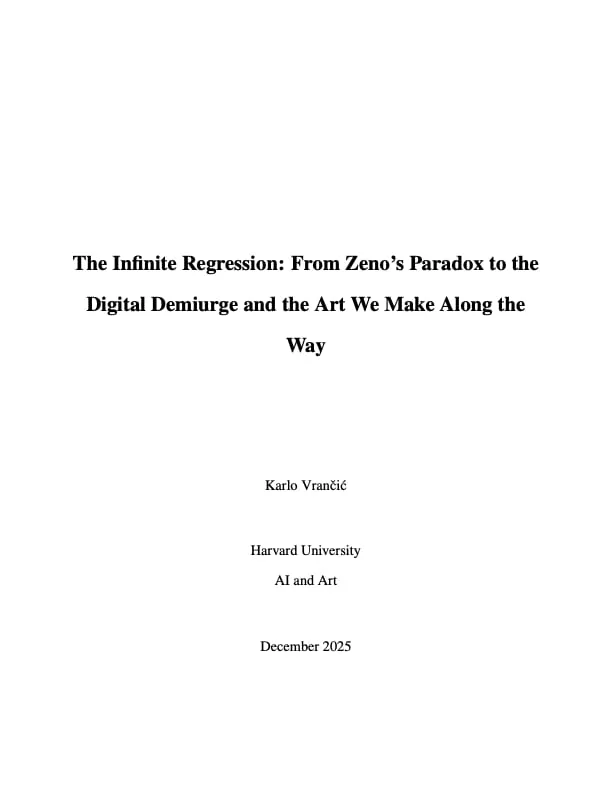
The Infinite Regression: From Zeno's Paradox to the Digital Demiurge and the Art We Make Along the Way
Zeno argued that an arrow in flight is standing still at every instant. Calculus answered him by assuming that motion is continuous, and AI video quietly breaks that assumption again, because a diffusion model draws a new arrow in every frame. The paper follows the problem from Aristotle through Bergson to VideoForge, the tool I built to keep the arrow the same arrow, and then asks what creativity means when a model can recombine everything we have made. It ends with the uncomfortable part, which is that we are now the ones making digital beings.